
26/06/2012

20/06/2012
POWER TOWER Audio

24/05/2012
(In)Flexible Cities - Power Tower
Please join us next Tuesday (29th May) for 'Power Tower', the final CRASSH
City Seminar event of this academic year. We are very pleased to be
welcoming Professor John Milner (Courtauld Institute)and the artists HenryVIII's Wives to discuss the Tatlin Tower in relation to the ArcelorMittalOrbit in London's Olympic Park. The event will be followed by a wine reception at CRASSH.

The event is envisaged as an exploration of the legacy of Tatlin's tower,
and the manner of its (un)realization in the form of the Orbit by Anish
Kapoor and Cecil Balmond. How does the Orbit relate to the transformatory
impact the Tatlin tower was intended to have on social forms and urban
structures? How are the relationships between monumental structures and
cities thought about across eras, spaces and political systems? And what of the
ideological contexts of the towers in Soviet Russia and corporate London?
The event will start at 5pm in room S1 (N.B. 1st floor), CRASSH, Alison
Richard Building, 7 West Road.
Event info online here.
Image of the Orbit c/o Arcelor Mittal.
City Seminar event of this academic year. We are very pleased to be
welcoming Professor John Milner (Courtauld Institute)and the artists HenryVIII's Wives to discuss the Tatlin Tower in relation to the ArcelorMittalOrbit in London's Olympic Park. The event will be followed by a wine reception at CRASSH.

The event is envisaged as an exploration of the legacy of Tatlin's tower,
and the manner of its (un)realization in the form of the Orbit by Anish
Kapoor and Cecil Balmond. How does the Orbit relate to the transformatory
impact the Tatlin tower was intended to have on social forms and urban
structures? How are the relationships between monumental structures and
cities thought about across eras, spaces and political systems? And what of the
ideological contexts of the towers in Soviet Russia and corporate London?
The event will start at 5pm in room S1 (N.B. 1st floor), CRASSH, Alison
Richard Building, 7 West Road.
Event info online here.
Image of the Orbit c/o Arcelor Mittal.
21/03/2012
Ash Amin - audio
The audio for Ash Amin's talk 'Telescopic Urbanism' is now available online. Click here to listen.
01/03/2012
Ash Amin - Telescopic Urbanism

Next week Professor Ash Amin (Geography, Cambridge) will be talking to the City Seminar with the title 'Telescopic Urbanism'.
Here's the abstract:
By 2030 between a third and half of the world's population will be leading a precarious, and often abject, life in the neglected urban interstices. Urban scholarship is beginning to turn to this eye-watering problem, and to questions of sustainable urban competitiveness and growth, but interestingly without referencing one to the other. This paper claims that the 'endless city' is being looked at through the wrong end of the binoculars, with 'business consultancy' urbanism largely disinterested in the city that does not feed international competitiveness and business growth, and 'UN-Habitat' urbanism looking to the settlements where the poor are located for bottom-up solutions to human well-being. The paper muses on the implications of such an urban optic on the chances of the poor, their areas of settlement, and their expectations of support from others in and beyond the city. While acknowledging the realism, inventiveness and achievements of effort initiated or led by the poor, the paper laments the disappearance of ideas of mutuality, obligation and commonality that telescopic urbanism has enabled, in the process scripting out both grand designs and the duty of distant others to address the problems of acute inequality and poverty that will continue to plague the majority city.
For more info please click here.
23/02/2012
(In)flexible Cities podcasts
21/02/2012
Urban Reflections talk today
Professor Mark Tewdwr-Jones (UCL Bartlett) will be talking this evening as part of the (In)flexible Cities series. His title is 'Urban Reflections - Filmic Narratives of Place, Planning and Change' . The seminar starts at 5pm and will be in room SG2 at CRASSH, Alison Richard Building, 7 West Road.
Here is some information about the event:
‘The eye does not see things, but images of things that mean other things.’ Italo Calvino's comment from 'Invisible Cities' captures the role and value of film in the urban realm. Cities have long been a feature of motion pictures and the use of urban landscapes for the setting has taken varied forms since the dawn of cinema more than 100 years ago. These landscapes form part of the narrative text to film that are necessary to convey a unified sense of space. The eclecticism of the contemporary study of cities - associated with a growing body of theory on place identity, on ‘placeness’, and spatial awareness, on the interrelations between place, space, people and politics, with a long standing interest in urban form and city life - provides an opportunity for an alternative critical perspective, gleaned from celluloid representation, that might explain the prevalence and significance of people's perceptions of places that social scientists often feel remote from or unable to discern. Similar to maps, films are just another way of looking at the world but evoke matters concerning power and contestation. Film as a product of modernity captures perfectly the dynamism of modernism and its impact of cities and landscape, looking forward excitedly at the prospect of the utopian future while glancing backwards and with nostalgia to familiar, cherished and vanishing scenes. Massey talks about space as ‘the sphere of the existence of multiplicity’. Perceptions of space, of representations and imaginations, will be multiple too. This is where the camera lens has the advantage - depicting multiple meanings of places, representing difference and distinctiveness, and challenging existing perceptions of places we think we already know well.
Mark Tewdwr-Jones is Professor of Spatial Planning and Governance at University College London Bartlett School. His work is multi-disciplinary, spanning planning, politics and governance, architecture and film studies, and housing and environment.
His latest book, Urban Reflections: Narratives of Place, Planning and Change, was published in 2011. It provides a series of narratives that examine our perception of place and change, both through official town planning accounts and through literary, cinematic and social depictions and reactions to urban change and development.
06/02/2012
City Seminar #2 - Karen Till on Wounded Cities

Tomorrow we're welcoming Dr Karen Till (National University of Ireland, Maynooth) to Cambridge to talk about 'Wounded Cities', the title of her current book project.
The talk starts at 5pm, SG1 at CRASSH, Alison Richard Building, 7 West Road. Please click here for more info.
Here is the abstract for Karen Till's talk:
In contrast to theorizing cities that have experienced disaster or trauma as systems that need to become more resilient, in this talk Karen Till argues that cities marked by past structures of violence and exclusion should be understood as both wounded places and as environments that offer its residents care. The talk draws upon her book in progress and ethnographic research in Bogota, Cape Town and Roanoke, Virginia -- cities in which settlement clearances have produced spaces so steeped in oppression that the geographies of displacement continue to structure urban social relations. She will introduce her concepts of 'wounded city', 'memory-work' and a 'place-based ethics of care' as a means of retheorizing the city. She argues that the memory-work of artists, activists and residents offer alternative models to imagine more socially just urban futures. A deeper appreciation of the lived and place-based experiences and expertise of these urban inhabitants would enable planners, policy makers and urban theorists to consider more ethical and sustainable forms of urban change.
24/01/2012
CITY SEMINAR #1 (LENT TERM): KINSHASA ON FILM

The first city seminar of Lent term is already next Tuesday (31 January). Further seminars will take place on the following Tuesdays: 7 February, 21 February and 6 March. Please click here for a link to the programme.
Tuesday's seminar (Kinshasa on Film: Between Dystopia and Utopia) is a special event, a screening of two films on Kinshasa, plus a discussion with the directors: anthropologist Professor Filip De Boeck from KU Leuven and architect/curator Koen Van Synghel. Van Synghel and De Boeck have carried out a number of urban-focussed projects together, including the Belgian Pavilion at the 2004 Venice Architecture Biennale, which won the Golden Lion.
Please note that this event will start at the earlier time of 4.15pm, and will run until 7pm.
De Boeck and Van Synghel with show extracts from two films: Cemetery State (2010, dir. Filip De Boeck), which deals with the urban politics of death in a Kinshasa graveyard; and an excerpt entitled The Tourist City from the film The World According to Bylex (2008, dir. Koen Van Synghel and Filip De Boeck), which takes the form of an interview with Bylex, a utopian artist and social visionary from Kinshasa.
For an abstract of the event, please click here.
The film showings will be preceded by an introduction from the directors, and followed by a discussion. This promises to be a very exciting event indeed - we hope to see many of you there!
19/01/2012
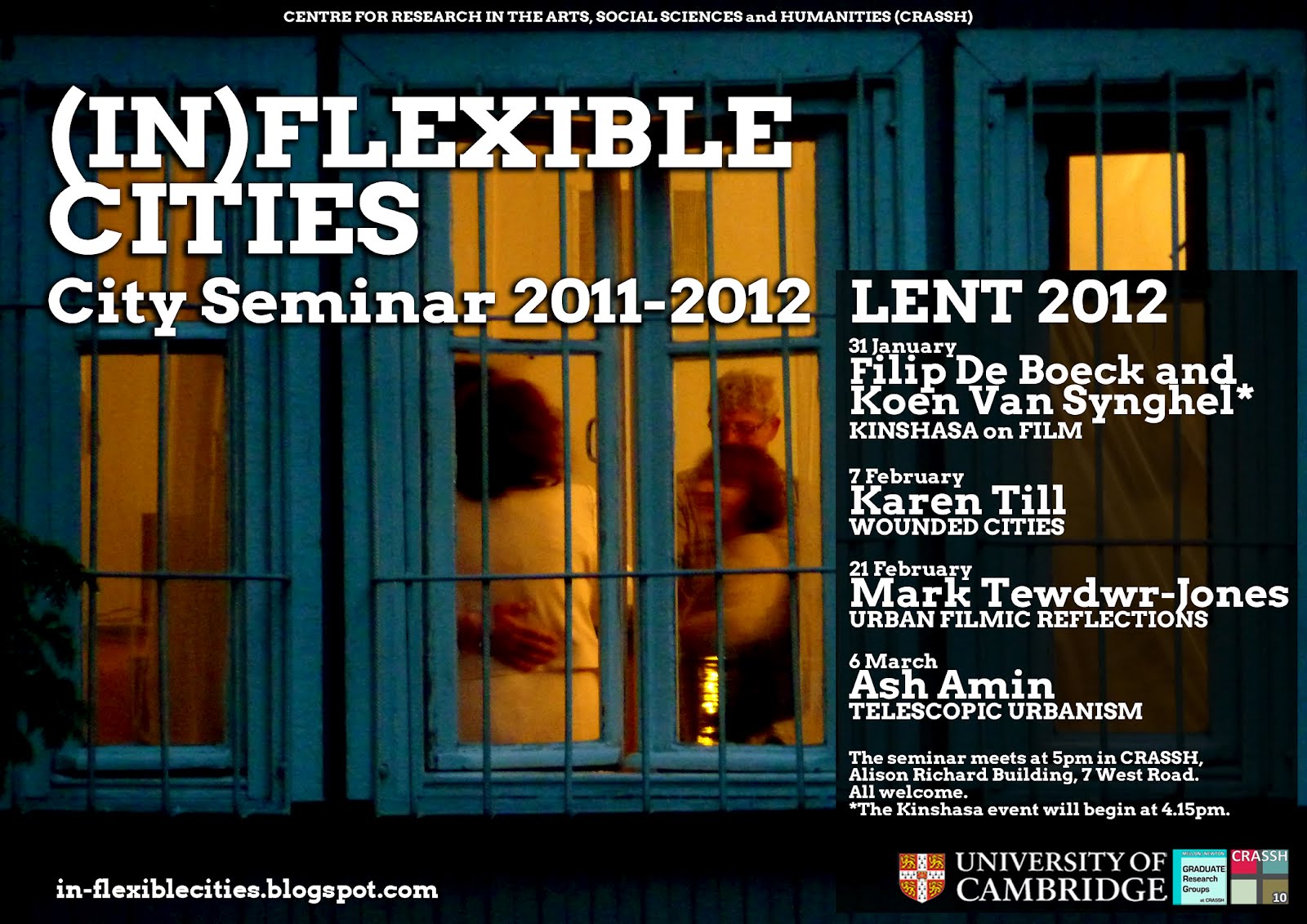
LENT 2012 PROGRAMME

The City Seminar meets on Tuesdays at 5pm in the Seminar Room at CRASSH's *NEW* headquarters, the Alison Richard Building, 7 West Road. All are welcome.
31 January (16.15 - 19.00)
KINSHASA ON FILM (film showing and discussion with the directors): Cemetery State (72') and The Tourist City (15')
Professor Filip De Boeck (Anthropology, KU Leuven) and Koen Van Synghel (architect and curator)
7 February (17.00 - 18.30)
WOUNDED CITIES
Dr Karen Till (Geography, National University of Ireland, Maynooth)
21 February (17.00 - 18.30)
URBAN REFLECTIONS: FILMIC NARRATIVES OF PLACE, PLANNING AND CHANGE
Professor Mark-Tewdwr-Jones (UCL Bartlett School of Architecture)
6 March (17.00 - 18.30)
TELESCOPIC URBANISM
Professor Ash Amin (Geography, Cambridge)
01/12/2011
Anique Hommels Podcast


Click here to listen to the podcast of Anique Hommels' talk.
The images (courtesy of Anique) show aerial views of the Dutch town of Enschede: immediately the fireworks depot explosion in May 2000 and a decade later.
See this Youtube clip for a record of the devastating force of the explosion (in particular after 2:20).
Anique Hommels on obduracy and vulnerability

The podcast for Anique Hommels' talk will be online soon.
Using examples from Utrecht and Enschede, and drawing on interviews and archival work, Hommels argued that cultural meanings play a key role in coping with obduracy and vulnerability in cities, as they are embedded in both technological frames (following Bijker) and in narratives of resilience (following Vale and Campanella). For instance, the response to the fireworks disaster in Enschede, Netherlands in 2000 provided an opportunity to make urban planning innovations and construct a positive story of regeneration. Resistance to change nonetheless manifests itself in urban space through the obduracy inherent in the reassertion of tradition and connections with the past.
18/11/2011
Seminar #4: Anique Hommels
Anique Hommels (Maastricht) - How Cities Cope with Obduracy and Vulnerability
Tuesday, 22 November 2011, 17:00 - 19:00
Location: CRASSH, 17 Mill Lane, Cambridge
City planning initiatives and redesign of urban structures often become mired in debate and delay. Despite the fact that cities are considered to be dynamic, innovative and flexible spaces, never finished but always under construction, it is very difficult to change existing urban structures. Cities become fixed, obdurate, securely anchored in their own histories as well as in the histories of their surroundings. Yet, if cities fall victim to a disaster, change of urban structures is sudden, unexpected and often seen as undesirable. At the same time, it is argued that urban disasters can bring about urban innovation and that cities can even benefit from them. The talk will discuss how cities cope with obduracy and vulnerability. Why is it so difficult to bring about urban innovation once urban structures are in place? How do cities respond to urban disasters? How can we explain the ‘rhetoric of innovation’ in cases of urban disaster? These issues will be discussed in relation to theories of obduracy and vulnerability in cities and illustrated with empirical cases.
Anique Hommels is associate professor at the Department of Technology & Society Studies, Maastricht University, the Netherlands. In her PhD thesis she concentrated on the resistance to change (‘obduracy') in urban sociotechnical transformation processes. A book (Unbuilding Cities - Obduracy in Urban Sociotechnical Change (2005). Cambridge, MA: The MIT Press), based on her thesis, has been published by MIT Press in 2005 (paperback edition Fall 2008). In 2003, she was awarded the Brooke Hindle Fellowship from the American Society for the History of Technology (SHOT). After her PhD, her research focus shifted to the problem of vulnerability of sociotechnical systems. She was one of the principle investigators in the ESF/Eurocores project "Europe goes Critical: The emergence and governance of critical transnational European infrastructures" (2007-2009). At the moment, she studies urban disasters and how such critical events generate urban innovation.
11/11/2011

02/11/2011
SEMINAR #3: Owen Hatherley. Tuesday 8 November

Owen Hatherley is a firebrand leftist critic of architecture and urban space. He is the author of Militant Modernism, an exhumation of urban utopias, A Guide to the New Ruins of Great Britain, on obsolete Blairite blob architecture, and Uncommon, on Pulp (the band). Owen writes regularly for the Guardian, New Statesman, Building Design and Socialist Worker, amongst others. He runs or contributes to numerous blogs, including: Sit down man, you're a bloody tragedy and Kino Fist.
ON THE PLAZA: POST-SOVIET URBAN ENSEMBLES
Among the many things that are anathema in contemporary urban planning, one of the most demonised is the large, ceremonial public square. The vast, proverbially windswept plazas built under 'really existing socialism' from the 1920s to 1980s are widely considered to be huge and useless spaces, designed to intimidate or at least impress, lacking the intimacy and bustle of the Italian-derived Piazza.
They are often considered a Soviet innovation, though their roots are in no way socialistic, but derive from Prussian and Tsarist absolutist planning, quasi-parade grounds usually connected to wide, multi-lane boulevards – the connection of the Palace Square to Nevsky Prospekt in St Petersburg is the prototype. Yet, if these places are only of use to those in power, why is it they have been used so often – and so often successfully – in protest? From Petrograd in 1917 to the Alexanderplatz protests of 1989, through the use of the Independence Square in Kiev in the 'Orange Revolution' to the Revolution centred on Cairo's partly Soviet-planned Tahrir Square, these spaces have become focuses for mass protest – have been useful against power, in other words.
In this paper we will explore this seemingly authoritarian form of urbanism. Though focusing on the architectural spaces of these squares, it will be argued that paradoxically, these centres of power are more conducive to revolt than the new, ostensibly democratic spaces.
26/10/2011

21/10/2011
(In)flexible Cities Seminar #2: Contested Spaces and Urban Citizenship in India
Romola Sanyal’s talk will address multiple narratives of Dharavi, Mumbai and how these competing and complimentary narratives produce particular claims to citizenship. Much of the work is based around her recent and brief fieldwork in Dharavi, but also draws on postcolonial theory. The fieldwork entailed going on several ‘slum tours' and the talk will pick up on how the slum is narrated through these and other media.
Romola Sanyal is Lecturer in Global Urbanism at Newcastle University. Her work focuses on the intersection between Refugee Studies and Urban Studies in trying to understand how refugee spaces urbanize. Studying refugee 'colonies' in Calcutta and camps in Beirut, the work endeavours to show how the production of space is central to the production of refugee identity and rights. The aim is not only to debunk widely held beliefs that refugee camps form spaces of exception, by pointing to the complexity of relations that construct refugee identities and spaces, but to show how these sites are becoming increasingly informalized and urbanized as a result of particular geopolitics. Her work studying the refuge through the lens of the city raises critical questions of identity, citizenship and belonging can be raised particularly in relation to space and place.
Romola Sanyal has published in journals such as Traditional Dwellings and Settlements Review, Social Identities (2009), Urban Studies (2011), Geography Compass (forthcoming), and has chapters in forthcoming books such as Urbanizing Citizenship: Contested Spaces in Indian Cities (Renu Desai and Romola Sanyal, eds) and The Postconflict Environment (Daniel B. Monk, ed). Her book Urbanizing Citizenship: Contested Spaces in Indian Cities (Sage, India) is forthcoming in November, 2011. Her Ph.D. dissertation Architectures of Displacement: On Identity and Refugee Space in Beirut and Calcutta won the 2010 Social Science Research Council-IDRF Book Fellowship award.
Before coming to Newcastle, Romola worked at University College London and at the Open University and was the inaugural postdoctoral fellow at the Chao Center for Asian Studies, Rice University. She has a Ph.D in Architecture from University of California, Berkeley and an M.Sc in Cities, Space and Society (Geography) from the London School of Economics. She currently serves on the executive board of the International Association of the Study of Traditional Environments.
Romola Sanyal is Lecturer in Global Urbanism at Newcastle University. Her work focuses on the intersection between Refugee Studies and Urban Studies in trying to understand how refugee spaces urbanize. Studying refugee 'colonies' in Calcutta and camps in Beirut, the work endeavours to show how the production of space is central to the production of refugee identity and rights. The aim is not only to debunk widely held beliefs that refugee camps form spaces of exception, by pointing to the complexity of relations that construct refugee identities and spaces, but to show how these sites are becoming increasingly informalized and urbanized as a result of particular geopolitics. Her work studying the refuge through the lens of the city raises critical questions of identity, citizenship and belonging can be raised particularly in relation to space and place.
Romola Sanyal has published in journals such as Traditional Dwellings and Settlements Review, Social Identities (2009), Urban Studies (2011), Geography Compass (forthcoming), and has chapters in forthcoming books such as Urbanizing Citizenship: Contested Spaces in Indian Cities (Renu Desai and Romola Sanyal, eds) and The Postconflict Environment (Daniel B. Monk, ed). Her book Urbanizing Citizenship: Contested Spaces in Indian Cities (Sage, India) is forthcoming in November, 2011. Her Ph.D. dissertation Architectures of Displacement: On Identity and Refugee Space in Beirut and Calcutta won the 2010 Social Science Research Council-IDRF Book Fellowship award.
Before coming to Newcastle, Romola worked at University College London and at the Open University and was the inaugural postdoctoral fellow at the Chao Center for Asian Studies, Rice University. She has a Ph.D in Architecture from University of California, Berkeley and an M.Sc in Cities, Space and Society (Geography) from the London School of Economics. She currently serves on the executive board of the International Association of the Study of Traditional Environments.
13/10/2011
(In)flexible Cities Seminar #1: Cities of Power

For the opening talk of the (In)flexible Cities series Professor Göran Therborn gave an overview of his ‘Cities of Power’ project, which focuses on cities as representations of power and as sites of power. We had a fantastic turnout, so thanks to everyone who came. Technology defeated us so we don’t have a podcast for the first talk, but here are some of the key ideas Professor Therborn covered.
The talk made a broad portrait of cities of power, questioning whether cities really do wield power and analyzing how power is represented in the city. Therborn's project has a strong emphasis on iconography and representation, including urban layout, architecture, monuments and toponymy. Therborn opened his talk by warning against economistic reductionism and misperceptions of state power. Therborn then distinguished between cities of power and the power of cities, because of what he terms the problematic ‘agency of places’ (do cities really wield power?). The city as ‘command point’ (Sassen) is a site, but not an agent of power: the persons who actually wield power can be better understood as agents of corporations (public, private) and not of cities. The city does not hold the power, even though power is located in the city. Corporate networks and armed forces are forms of power manifested in cities: cities as sites of power.
Therborn suggested that cities wield power as nodes in networks of other cities. They also wield power as resource-holders, service providers and governors of sociability. More importantly, though, they exert influence as representations of power: commanding respect, asserting legitimacy and expressing direction or worldview. Cities represent through spatial layout, the patterning of private and public buildings, through architecture itself, and in their monuments and museums (Therborn calls this the ‘monumentality’ of cities). In illustrating the theme, Therborn highlighted the multivalence of form in sites such as the Christ the Saviour cathedral in Moscow, a symbolic project which is open to numerous interpretations, due to its detonation, the proposed use of the site for the Palace of the Soviets , and its existence as the Moskva swimming pool until its reconstruction in 1995.
So how does the idea of ‘cities of power’ relate to (In)flexible Cities? Sites of power, said Therborn, also become sites of resistance to power. The multivalency of urban representations offers one possible site of internal resistance. Another is created by contextual constraints, which can defeat even strong political will (one example would be the various attempts to block improvements on London's Kingsway at the turn of the 20th century). A surprising aspect of resistance to cities of power, Therborn suggested, is that the contestation of power often comes from elsewhere, from another city. Therborn gave examples including the importance of Leipzig to the fall of the Berlin Wall in 1989, of Benghazi to the fall of Tripoli, and the uprisings in Homs to the resistance movement against the Damascus regime.
30/09/2011
SEMINAR #1

Cities do not have much power in today’s world, and “global cities” are not moulding the world economy. But some cities, capitals in particular, are important sites of power. As such, they are strategic locations in the social structure of power, and they have crucial functions of representation. This CRASSH seminar will focus on how, in what variable forms, capital cities represent political power, which will take us to urban spatial forms and to urban political iconography and toponymy. Power entails (potential) resistance, and we shall pay attention to the cityscape of contestations of power.
Göran Therborn is Professor emeritus of Sociology at Cambridge, previously, co-Director of the Swedish Collegium for Advanced Study in the Social Sciences. He is the author of a number of books and articles on a wide range of topics, sometimes theoretical but mostly empirically macrosocial, comparative, and with a historical dimension. His latest book is a historical sociology of the world, The World. A Beginner’s Guide (Polity 2011)
He has an ongoing global project on Cities of Power, which has resulted in a number of book and article publications.
MICHAELMAS TERM 2011 PROGRAMME

All events will be held at 5pm in the CRASSH Seminar Room, 17 Mill Lane, Cambridge. A wine reception will follow.
11 October 2011
CITIES OF POWERProfessor Göran Therborn (University of Cambridge)
25 October 2011
Dr Romola Sanyal (University of Newcastle)
8 November 2011
Owen Hatherley (firebrand leftist architecture critic)
22 November 2011
Subscribe to:
Posts (Atom)